

Djerdap National Park: Iron Gates Gorge, Golubac and Lepenski Vir
This post contains affiliate links. If you book through them, we may earn a commission at no extra cost to you.
Djerdap National Park is Serbia’s largest national park, on the Danube along the border with Romania, about 130 km east of Belgrade at its western end. It protects the Djerdap gorge, better known as the Iron Gates gorge, where the river cuts through the Carpathian mountains for about 100 km. The main things to see are Golubac Fortress, the narrow Kazan Gorge and the prehistoric site of Lepenski Vir, and you can see all three on a long day trip from Belgrade.
You’ll also see the name written as Đerdap or Derdap. In Serbian it’s Nacionalni park Đerdap. This guide covers the main sights, boat rides, hiking and cycling, the best time to go, how to get there and where to stay.
Why Visit Djerdap National Park
The basics:
- Location: eastern Serbia, on the right bank of the Danube, from Golubac to near Kladovo
- Size: over 63,000 hectares, the biggest national park in Serbia
- The gorge: about 100 km long, one of the longest river gorges in Europe
- Protected as a national park since 1974
- Part of the Djerdap UNESCO Global Geopark (since 2020)
- History: from Stone Age settlements to Roman roads and medieval fortresses
The park is not one single attraction. It’s a long strip of river, cliffs and forest with sights spread along the road that follows the Danube. People settled here around 9,000 years ago, the Romans cut a road into the cliffs, and medieval kingdoms fought over the fortress at the entrance to the gorge. Today you can take a boat between the cliffs, hike up to viewpoints high above the water, or cycle along the river.
Top Sights in Djerdap National Park
Golubac Fortress: The Gate to the Gorge
Golubac Fortress stands where the Danube enters the gorge, with its walls and towers climbing the rocks right above the water. It dates from the 14th century and changed hands many times between Hungarians, Serbs and Ottomans. After a long restoration it reopened to visitors in 2019, with a visitor center at the entrance.
What to expect:
- Walls and towers you can climb, with views over the river to Romania
- Steep stairs and uneven stone paths inside the fortress
- A small exhibition about the fortress’s history
- The local legend of Golubana, a girl who was said to have refused a Turkish pasha
Tips:
- Wear shoes with good grip for the tower stairs
- Go early or late in the day in summer, when it’s cooler and quieter
- Check current ticket prices and opening hours before you go
- Plan about 1.5 to 2 hours if you want to climb the upper towers
Lepenski Vir: One of Europe’s Oldest Settlements
Lepenski Vir is a prehistoric settlement on the Danube, discovered in the 1960s. People lived here between roughly 9,500 and 7,000 years ago, long before Stonehenge was built. When the Iron Gate dam was built and the river rose, the whole site was moved about 30 meters higher up the bank, and that is where you see it today.
Why it matters:
- Houses with a trapezoid floor plan, laid out in a planned way
- Stone sculptures with faces that look half human, half fish
- It shows how hunters and fishers slowly became settled farmers
What you’ll see:
- A museum with finds, models and copies of the sculptures
- The original house foundations under a large glass roof
- A quiet spot on the river bank, a good break on a long drive
Plan about an hour here. If ancient sites are what you travel for, our archaeology tours in Serbia cover more places like this.
Kazan Gorge: The Narrowest Part of the Danube
Kazan (the “cauldron”) is the most dramatic part of the Djerdap gorge. Here the Danube squeezes to about 150 meters wide between steep limestone cliffs, and it’s also one of the deepest stretches of the river. You can see it from the road, from viewpoints above, or best of all from a boat.
Other Stops Along the Danube
- Tabula Traiana: a Roman plaque cut into the cliff about 1,900 years ago to mark Emperor Trajan’s road through the gorge. It’s best seen from the water.
- Decebalus rock sculpture: a huge face of the Dacian king carved into the Romanian side of the gorge in the 1990s and 2000s, visible from boats in the Kazan area.
- Donji Milanovac: a small town in the middle of the park, with the park’s visitor center and a riverside promenade.
- Iron Gate I dam (Đerdap I): the big hydro power plant near Kladovo, which also works as a border crossing to Romania.
- Near Kladovo: the remains of the Roman fort Diana and the pillars of Trajan’s Bridge, just outside the gorge.
Things to Do: Boat Rides, Hiking, Kayaking and Cycling
Boat Rides Through the Iron Gates Gorge
A boat ride is the easiest way to feel how big the Iron Gates gorge is. Most trips are fast speedboat rides of about an hour that go into the Kazan section, so you see the cliffs, the Roman plaque and the Decebalus sculpture up close.
Highlights from the water:
- Tabula Traiana on the Serbian side
- Decebalus Rex on the Romanian side
- The Kazan Gorge, where the cliffs come closest together
- Birds over the water, such as cormorants and herons
Tips:
- Bring a light jacket: it gets windy on a speedboat, even in summer
- Boat rides depend on the weather and the river, so they can be shortened or cancelled
- Many boat trips run mainly from spring to autumn, so check dates if you travel in winter
- Book ahead for summer weekends, when boats fill up
Hiking Trails and Viewpoints
The park has marked trails through beech and oak forest, and the best ones end at viewpoints high above the river. The most popular are around the Kazan Gorge.
- Veliki Štrbac: the highest viewpoint above the Kazan Gorge (768 m), with the classic view down onto the river. A steep but popular hike.
- Mali Štrbac: a lower peak nearby, also with views over Kazan.
- Ploče: a viewpoint above Kazan that you can reach with less effort than the Štrbac peaks.
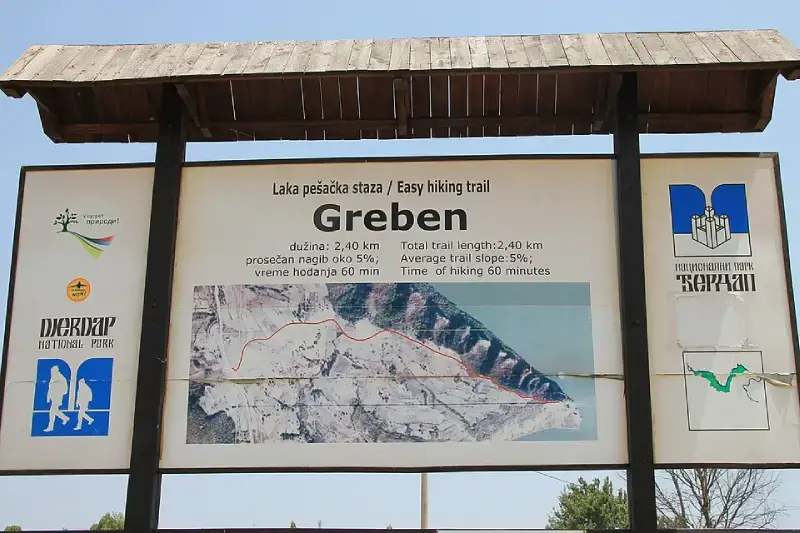
- Boljetinska reka and Greben: trails along a stream and a rocky ridge between Donji Milanovac and Golubac.
Trail conditions and markings change, so ask at the visitor center in Donji Milanovac before you set off, and don’t hike to exposed viewpoints in rain or ice. For more trails around the country, see our guide to hiking in Serbia.
Kayaking on the Danube
Paddling under the cliffs is a slow, quiet way to see the gorge. Local outfitters run guided kayak trips, usually in the warmer months, from short paddles for beginners to longer trips through the gorge.
- Go with a guide: the Danube is wide, with wind, currents and large boats
- Kayaks and life jackets are normally provided
- Summer is the main season; check if trips run outside it
Cycling the EuroVelo 6 Through Djerdap
The EuroVelo 6 long-distance cycle route follows the Danube right through the park, from Golubac to Kladovo. It’s one of the most scenic parts of the whole route, with the river on one side and cliffs on the other.
What to know before you ride:
- Much of the route is on the main road, shared with cars and trucks
- There are many short tunnels after Golubac, some without lights: bring front and rear lights and a reflective vest
- The road has some climbs, but most of it follows the river
- Golubac, Donji Milanovac and Kladovo are the easiest places to stop for the night
- Mountain bikers can also find forest roads inland, away from the traffic
Nature and Wildlife
Most of the park is forest, and the gorge’s mild climate lets some plants survive here that disappeared elsewhere in Europe after the last ice age. Turkish hazel (also called bear hazel) is the best-known example.
Animals that live in the park:
- Lynx, wolf and brown bear (rare, and you’re very unlikely to see them)
- Deer and wild boar, mostly at dawn and dusk
- Birds of prey and the eagle owl on the cliffs
- Water birds such as cormorants and herons along the river
Bring binoculars, stay on the trails and keep your distance from animals. If wildlife and landscapes are your main interest, browse our nature tours in Serbia.
Djerdap Tours from Belgrade
If you don’t have a car, a guided day trip is the simplest way to see the park. Most tours leave Belgrade in the morning, drive along the Danube and return in the evening. The usual stops are Golubac Fortress and a speedboat ride through the gorge, and some tours add Lepenski Vir and viewpoints above Kazan.
- Want to see as much as possible in one day? Pick a group trip with a speedboat ride through the gorge, Golubac Fortress and Lepenski Vir.
- Short on time or energy? A simpler group trip covers Golubac Fortress and a one-hour speedboat ride.
- Traveling as a couple, family or small group? A private day tour from Belgrade lets you set the pace at the fortress and the gorge.
Note that some Djerdap tours run only from spring to autumn, so check the dates on each tour if you’re planning a winter visit.
For other trips out of the city, see all our day tours from Belgrade, or our private tours in Serbia if you’d rather have a guide and driver just for your group.
Best Time to Visit Djerdap National Park
Spring (April-May)
- Green forests and wildflowers
- Mild temperatures, good for hiking and cycling
- Fewer visitors than in summer
- Seasonal tours and boat rides start up again
Summer (June-August)
- All tours, boat rides and kayak trips running
- Hot days, so hike early and take plenty of water
- Busiest time at Golubac Fortress, especially on weekends
- Book tours and rooms ahead
Autumn (September-October)
- The forests turn yellow and red, usually best in October
- Comfortable weather for hiking and cycling
- Fewer crowds after the summer holidays
- Morning fog over the river, good for photos
Winter (November-March)
- Quiet, with very few visitors
- Some tours and boat rides don’t run; check before you plan
- Trails can be muddy or icy
- Golubac Fortress and Lepenski Vir stay open, but hours are shorter; check before you go
Overall, May, June and September are the easiest months: everything is open, and it’s not too hot or crowded.
How to Get to Djerdap National Park
By Car (Most Flexible Option)
- Belgrade to Golubac: about 130 km, roughly 2 to 2.5 hours, via Požarevac and Veliko Gradište
- Belgrade to Donji Milanovac (middle of the park): roughly 3.5 hours
- Inside the park, one main road follows the Danube from Golubac through Donji Milanovac to Kladovo
- Parking is available at Golubac Fortress, Lepenski Vir and the main viewpoints
By Bus
- Buses run from Belgrade to Golubac, Donji Milanovac and Kladovo
- There is no train line through the gorge
- Local buses between the sights are rare, so without a car a tour is much easier
- Timetables change, so check current departures before you go
From Abroad
- The nearest big airport is Belgrade Nikola Tesla
- From Romania, you can cross at the Iron Gate I dam between Drobeta-Turnu Severin and Kladovo
- Many Danube river cruises between Budapest and the Black Sea sail through the gorge
Where to Stay
You can see the main sights in a day, but staying a night or two lets you hike, cycle and see the gorge without rushing. There are no big resorts here. Most places to stay are small hotels, guesthouses and private rooms in the towns along the river.
- Golubac: closest to the fortress and to Belgrade, a good choice for a short trip
- Donji Milanovac: in the middle of the park, close to Lepenski Vir, Kazan and the hiking trails. The best base for 2-3 days.
- Kladovo: at the eastern end, near the dam and the Roman sites
- Campsites: there are a few along the river, popular with cyclists on the EuroVelo 6
Prices are generally lower than in Belgrade, but they rise in summer. Check current prices and book early for July and August.
Food: What to Eat in Djerdap
River fish is the local specialty. Most restaurants along the Danube have a terrace with a view of the water.
- Riblja čorba: a spicy fish soup made with Danube fish
- Grilled or fried river fish, such as catfish, carp and zander
- Grilled meat like ćevapi and pljeskavica, found everywhere
- Local rakija (fruit brandy) and wine from the Negotin region nearby
In the small villages, restaurants may close early or open only in season, so plan your meals around the towns.
Planning Your Visit
How Much Time You Need
- 1 day: Golubac Fortress, a boat ride in the gorge and maybe Lepenski Vir. Possible from Belgrade, but it’s a long day.
- 2-3 days: add a hike to a Kazan viewpoint, a kayak trip and a slower drive along the river
- 4+ days: cycle the gorge or combine it with the Roman sites near Kladovo
Costs
There is no general entry fee for the park itself. You pay for tickets at Golubac Fortress and Lepenski Vir, for boat rides and for guided activities. Prices change, so check them before you go.
Packing List
- Comfortable shoes with good grip
- Layers and a windproof jacket for the boat
- Sun protection (sunscreen, hat, sunglasses)
- Insect repellent (May to September)
- Water and snacks for hikes
- Cash, as some small places don’t take cards
Money-Saving Tips
- Visit in May, June or September, when rooms are cheaper than in peak summer
- Book rooms a few weeks ahead for summer weekends
- Pack a picnic for hiking days
- Without a car, a group day trip is usually cheaper than arranging transport and a boat yourself
Responsible Travel in the Park
- Stay on marked trails, especially near cliffs and viewpoints
- Take all your trash with you
- Don’t touch or climb on the remains at archaeological sites
- Keep your distance from wild animals and don’t feed them
- Eat and stay in local, family-run places when you can
- Learn a few words of Serbian, like “hvala” (thank you); people appreciate it
Djerdap National Park FAQ
Where is Djerdap National Park?
In eastern Serbia, along the Danube on the border with Romania. It runs from Golubac in the west to near Kladovo in the east. Golubac is about 130 km from Belgrade.
Is Djerdap the same as the Iron Gates?
Mostly, yes. The Iron Gates (Gvozdena vrata) is the name for the whole gorge of the Danube between Serbia and Romania. Djerdap is the Serbian name for the same gorge, and the national park protects the Serbian side of it.
Can you visit Djerdap National Park as a day trip from Belgrade?
Yes. A day trip usually covers Golubac Fortress and a boat ride in the gorge, and sometimes Lepenski Vir. It’s a long day with a lot of driving, so stay overnight if you want to hike or see the eastern part of the park.
How many days should I spend in Djerdap National Park?
One day is enough for the main sights. Two or three days let you add a hike to Veliki Štrbac, kayaking or cycling, without rushing.
Is Djerdap suitable for families with children?
Yes. Kids usually enjoy:
- Exploring the walls of Golubac Fortress (hold small children’s hands on the stairs)
- Boat rides through the gorge
- The museum and sculptures at Lepenski Vir
- Easy walks along the river in Donji Milanovac
Steep hikes like Veliki Štrbac are better for older kids.
Can I visit Djerdap in winter?
Yes, but with limits:
- Some tours and boat rides run only from spring to autumn
- Trails may be muddy, icy or snowy
- The upside: very few visitors and quiet roads
- Check opening hours for Golubac Fortress and Lepenski Vir before you go
Are guided tours necessary or can I explore independently?
Both work. With a car you can easily visit Golubac, Lepenski Vir and the viewpoints on your own, and book a boat ride locally. Without a car, a tour is much easier, because public transport between the sights is limited. A guide also explains the history that you’d miss on your own.
Is there an entrance fee for Djerdap National Park?
Not for the park in general. You pay separate tickets for Golubac Fortress, Lepenski Vir, boat rides and guided activities. Check current prices before you go.
Djerdap National Park gives you a medieval fortress, one of Europe’s oldest settlements and a deep river gorge, all within a few hours of Belgrade. Come for a day if that’s all you have, or stay two or three days to hike and paddle. Next step: browse our Golubac Fortress and Iron Gates tours and pick one that fits your dates.